From the Earth to the Moon
- Esther Izquierdo Martínez
- Sep 21, 2025
- 2 min read
And from the Roman Empire and the Renaissance to modern times.
Men (and women, yes) have always looked at the stars and have wondered. About universe, the stars, the laws that rule the celestial bodies and ourselves.
And we keep doing that, even now. The Universe is the last frontier. We aim to discover its secrets and who knows, maybe another place to live.
My next two characters have broken all limits to their times. One because she was a woman in a time where their strength and knowledge were reserved for the domestic space. The other because turned us back to be the little ants we have always been, instead of believing we were gods and the main actors in our own lives.
I am sure they would be as magnificent now as they were then.
From Roman Egypt and Poland, they are
Hypatia of Alexandria
Nicolas Copernicus
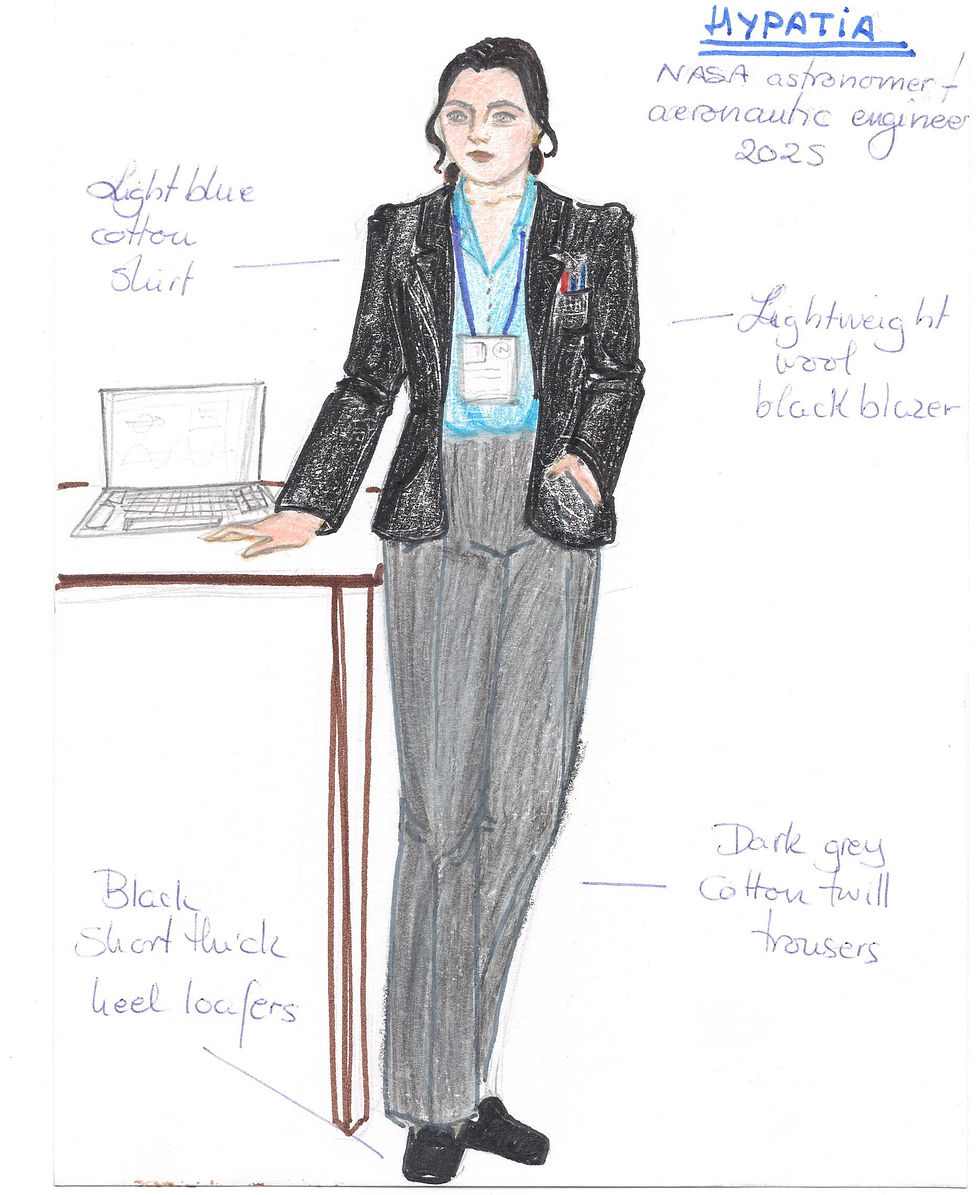
Hypatia as astronomer or aeronautical engineer. Free to pursuit her love for numbers and the celestial objects. Maybe she would not be as famous as she is now living in her times, because she would have been freer to be herself. And probably that would have grant her anonimity and definitely, would not have amazed or scandalized her contemporaries.
But I think she would have maybe been happier.
So it was easy to bring her to 2023. Same strength and fierceness shown by her comfortable and practical clothing, ideal for a working woman.
The palette and fabrics have been chosen to underline the importance she gives to clothing (barely anything, as it only serves for a couple of purposes: feel comfortable doing her task and the basic of covering the body) and her brain.
A remarkable woman.
Now and then.

When I thought of Nicolas Copernicus, it appears to me as a kind and warm man. Focused, Determined. Intelligent and calm. Copernicus understood. And started to give form and comprehension to the world and the skies: the Sun is the centre of the universe. It gives us life and we rotate around it drinking its power.
And as I imagined him, I could not help but thinking his palette and fabrics the same as Carl Sagan wore when making us love, understand and be mesmerized by the cosmos.
The warmth of the earth tones of shoes, jacket and turtleneck, ground and wrap him, and show his love for the space. His posture shows his firm attitude in the divulgation of knowledge.
A knowledge that could never be put to better use than in the career to conquer the moon: end of the 60s and beginning of the 70s.
The crossing arms his "no nonsense" frame of mind.
And the practical dark trousers to reinforce that.
With a man like him we can go to the moon and beyond.


Comments